
Remembering How We Breathe

Introduction
Colonialism systematically dismantles Indigenous relational ontologies that enable collective regulation. Systems organized around shared regulation, collective responsibility, and moral intent are fundamentally incompatible with extractive governance. To rule effectively, colonial powers had to break these collective systems. One of the earliest colonial interventions was the legal invention of the individual as the primary unit of responsibility. Colonial legal codes severed the feedback loop between action, intent, and communal repair, making punishment possible without healing.
For generations, Western schools, courts, and governments have been built on this shift. Harm is treated as an individual defect rather than a relational rupture. Responsibility is isolated from context, and repair is replaced with control. My ideas and writing, particularly regarding The Structural-Relational Power Ecology (SRPE), challenge this structure by returning to relational models of harm and healing that were never lost in egalitarian Indigenous worldviews, which are currently being suppressed through settler-colonial linguistics, colonial cognition, and associated modern-day coercive and predatory social norms. These norms are documented extensively in my recent book, Autism in America.
The phrase “I can’t breathe,” which is used as a protest slogan in the United States, can help make this entire framework visible in real time by naming, in the most literal and embodied way, what happens when relational and structural systems collapse onto the body. Used here, this refers to the suffocation of collective safety, moral recognition, and social protection. “I can’t breathe” is a diagnosis of a society that is not united but divided, having lost its capacity to regulate life together.
Moyo: The Shared Breath
Across many Bantu peoples in Central, Eastern, and Southern Africa, moyo is a polysemous term that carries multiple meanings. It is often translated as "heart," "breath," or "life," but those translations miss what the concept actually does. I understand moyo as a shared state in which all people exist together.
In Bantu languages such as Swahili, Shona, Kikongo, and Luba, moyo refers at the same time to vital force or life energy, emotional atmosphere or shared mood, moral orientation such as intent or sincerity, and relational health, meaning how people are with one another. There is no separation between feeling, intention, vitality, and social harmony. They all belong to the same domain and are inseparable.
Moyo is collective, not individual or private. In Bantu thought, a person does not regulate their own moyo in isolation. Moyo circulates between people. Groups, households, villages, and even rituals have a moyo state. I hear this in everyday language when people say the moyo of a gathering is heavy, that someone’s moyo is not with the group today, or that the moyo of the village has been disturbed. This is not a poetic metaphor, but rather diagnostic language describing the state of relationships.
Because of this, emotional disturbance is understood culturally as an ecological rather than an individual phenomenon. When someone is distressed, angry, withdrawn, or acting outside expected behavior, we ask what has disrupted the moyo between us. Common causes include broken relational obligations, shame or exclusion, unacknowledged grief, power imbalances, or loss of rhythm in work, ritual, or seasonal life. Repair focuses on restoring relational flow, reintegrating the person, and rebalancing the group, not fixing a supposedly disordered individual.
Regulation happens through co-regulation. Moyo is supported and stabilized through call-and-response speech, drumming and rhythmic movement, collective labor, storytelling, shared silence, and ritual acknowledgment of harm. The nervous system is not understood as something meant to self-soothe alone. Isolation from relational regulation appears harmful rather than healthy.
An important detail is that moyo includes intent. In Bantu ethics, what matters is not only what a person did, but the moyo they carried while doing it. Two identical actions can be judged very differently depending on whether they were done with care or resentment and whether the moyo was aligned with communal well-being. Morality here is relational and embodied, not rule-based or punitive.
Parallels to Lenni Lenape Thought
There is a closely related concept in Lenni Lenape and broader Algonquian thought that parallels moyo, but like moyo, it does not collapse into a single English word. I understand it as a cluster of meanings that move across breath, spirit, relational responsibility, and collective balance rather than something contained inside an individual.
Algonquian languages work very differently from Bantu languages. They are verb-heavy and process-oriented, meaning that significance lives in relationships and actions rather than in static nouns. These concepts are expressed in how life is lived and how relationships are maintained, not in fixed internal states.
The Lenni Lenape, also called Delaware, are part of the broader Algonquian language family. Across this family, the same function that moyo serves is present, though expressed through relational animacy and shared breath-spirit rather than an internal emotional condition.
For me, the most important starting point is Manëtuw, sometimes rendered as Manitou. In Lenape and related Algonquian languages, Manëtuw refers to spirit, mystery, or animating force. It is not an individual soul. It exists in people, land, animals, weather, relationships, and events. What matters is that Manëtuw flows between beings rather than residing inside isolated selves. A community, a river, a council, or even a conflict can all have a particular state of Manëtuw. This maps closely to moyo, which denotes shared vitality.
Another related concept is Pëmàtsëwën or Pimâtisiwin, often understood as life in motion. In Algonquian thought, life is not something you possess. It is a process of living well in relation. This includes emotional harmony, social balance, and ethical conduct, and it cannot be achieved alone. When relationships fracture, life itself becomes constrained in real and material ways.
In Lenape thought, breath, heart, will, emotion, intention, vitality, and morality are not treated as separate domains. What Western frameworks might call emotion is understood instead as relational alignment or misalignment. Rather than saying a person is dysregulated, a Lenape framing would say that relations are out of balance or that “the breath between us is disturbed.” This functions in the same structural way as moyo.
Animacy is central to this worldview. Algonquian languages classify the world by animacy rather than objecthood. Humans, animals, plants, winds, drums, stories, and places are all animate. Emotions are not located inside a person. They are events that move through animate relations. Shared emotional states are therefore real at the level of being, not symbolic or metaphorical.
Just as moyo cannot be reduced to emotion and Manëtuw cannot be reduced to spirit, both traditions refuse the split between individual and collective, mind and body, and human and nature. They encode relational nervous systems directly into language and practice.
When I map these frameworks onto each other, the alignment is clear: moyo, as a shared emotional field, corresponds to shared animacy or Manëtuw. Vital force corresponds to breath and life lived in relation. Moral intent felt in the body corresponds to right relation lived through action. Dysregulation, understood as social rupture, reflects an imbalance in relationships. Healing through co-regulation corresponds to healing through relational restoration. These are different language families expressing the same social ecology of feeling.
What I am doing with Structural–Relational Power Ecology and Mirror Integration Theory is not new in the way Western academia usually imagines novelty. I am rearticulating these Indigenous relational ontologies in a language that settler colonial courts, institutions, and policy systems could be compelled to engage with. Moyo and Manëtuw function as diagnostic tools for collective harm. They were sidelined precisely because they make systems accountable rather than allowing harm to be blamed on individuals.
Parallel Concepts Across ALL Indigenous Cultures
As I trace moyo and its parallels in Lenni Lenape thought, it became clear to me that this is a pattern and interconnected framework. Across Indigenous cultures worldwide, closely related concepts understand life, emotion, morality, and regulation as relational, collective, and ecological rather than individual or internal. These traditions use different languages and symbols, but they perform the same social function. They describe how humans stay regulated together and how harm and healing move through relationships rather than remaining within isolated individuals.
In many Southern African cultures, Ubuntu refers to a form of personhood that exists only through relationship, where harm to one person weakens the whole, and healing requires communal restoration rather than punishment. In the Nile Valley, Ma’at described moral, social, and cosmic balance as inseparable, with emotional disorder and social injustice understood as threats to collective order itself. Among Kanaka Maoli in Hawaiʻi, Aloha refers not simply to affection but to shared breath, presence, and reciprocal responsibility within a relationship. For the Diné, Hózhó denotes a state of balance and harmony that includes emotional regulation, ethical conduct, and right relations with the land and community.
In the Andes, concepts such as Buen Vivir or Sumak Kawsay define well-being as collective and ecological, insisting that a good life cannot exist without balance between people, community, and land. Inuit understandings of Sila link breath, weather, consciousness, and moral order, treating emotional imbalance as a disruption in relational attunement rather than an internal failure. In Indigenous Filipino psychology, Kapwa describes the self as shared, locating emotion and moral responsibility between people rather than inside individuals. Māori concepts such as Mauri and Whanaungatanga connect life force to kinship networks, where damage to relationships diminishes collective vitality. Even traditions shaped by Daoist cosmology describe Qi as a vital energy that flows through bodies, relationships, and environments, with health depending on circulation and balance rather than control.
Across these cultures, the pattern is consistent. Emotion is relational, regulation is collective, morality is embodied and not debatable, and health is ecological. What changes is the language, not the underlying structure. This convergence matters because it shows that relational regulation is not metaphor, spirituality, or cultural ornament. It is a repeatable, cross-cultural model of human functioning that colonial systems had to dismantle in order to govern through fragmentation, punishment, and individual blame.
Tracing the Deliberate Destruction of Collective Regulation
I am currently enrolled in the Native American History class (HIST 308) at Washington State University in Vancouver. When I trace this history structurally rather than rhetorically, it becomes clear that the destruction of shared regulation was not collateral damage of colonialism; it was an intentional governance strategy. Systems organized around collective responsibility, relational authority, and repair through reintegration are resistant to domination because power is distributed rather than centralized. Such systems frustrate taxation, policing, conscription, and large-scale extraction. To rule effectively, colonial powers had to dismantle the relational infrastructures that sustained collective regulation.
One of the earliest mechanisms for doing so was the creation of what historians describe as “shatter zones.” I previously wrote about shatter zones in my post, "The Contact Zone Never Closed," where I discuss colonialism as an active, ongoing project. These are not natural cultural evolutions but predictable outcomes of invasion combined with epidemic disease, militarized trade, and slave raiding.
In the seventeenth-century Southeast, Indigenous societies were transformed by participation in a colonial economy built around animal skins and captive labor, an economy that required constant violence to sustain itself (Ethridge). Warfare became economically incentivized, peace-making structures collapsed, and communities were destabilized through forced migration, amalgamation, and population loss (Ethridge). This was the systematic fracturing of the relational ecologies that made collective regulation possible.
Epidemics compounded this disruption. Massive population loss did more than reduce numbers. It overwhelmed the social networks that organized daily life, including food production, caregiving, and collective labor. As Fountain and McCoy document, mortality was so widespread that it often became impossible to sustain basic communal functions, leaving surviving populations vulnerable to external control and dependency (Fountain & McCoy). When relational systems collapse under strain, new authorities can be imposed more easily because the community’s capacity for coordinated response has already been weakened.
Colonial legal doctrine then made this disruption durable. The Doctrine of Discovery and related concepts, such as terra nullius, reframed Indigenous peoples as occupants rather than sovereign owners of land. These ideas were not confined to theology. They became embedded in U.S. law, most notably in Johnson v. M’Intosh (1823), which explicitly denied Native land rights on the basis of European discovery (Blakemore). Once relational land stewardship was rendered legally irrelevant, governance could proceed through centralized institutions that stood outside Indigenous relational systems.
The next critical site of intervention was family life. Colonial governance repeatedly targeted the people and practices responsible for maintaining relational continuity across generations. As Blackhawk documents, federal policies deliberately intervened in “the most intimate forms of Indian life,” including kinship, caregiving, and childrearing (Blackhawk). Boarding schools, child removals, and compulsory education were not simply cultural assimilation efforts. They were technologies for severing intergenerational co-regulation. Children were removed from their communities through coercion, including food deprivation, legal threats, and forced enrollment. They were punished for speaking Indigenous languages and subjected to widespread neglect and abuse (Blackhawk). From a relational perspective, this amounted to an intentional dismantling of the social infrastructure that sustains collective regulation.
This strategy continued into the twentieth century through adoption and foster placement policies. During the Termination Era, between one-quarter and one-third of American Indian children were removed from their families and placed in institutions or non-Native homes (Blackhawk). Congressional investigations later described this as a crisis in which rates of involuntary separation far exceeded those experienced by the general U.S. population. These removals further fractured kinship networks and normalized the idea that relational disruption was an acceptable tool of governance.
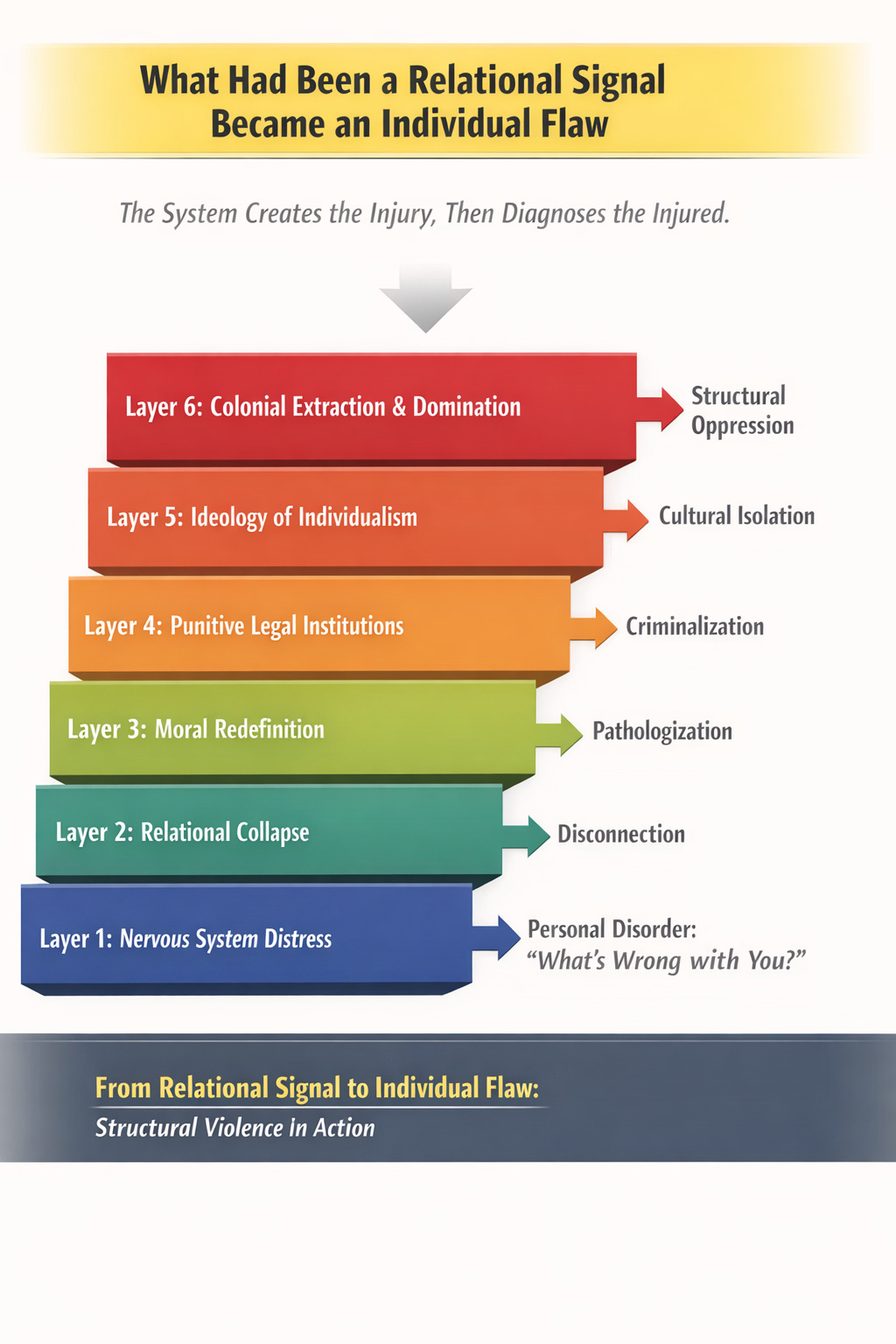
Once collective regulation had been sufficiently damaged, colonial systems reframed the resulting distress as individual pathology. Relational collapse was renamed emotional instability, dependency, irrationality, or moral weakness. From a Structural–Relational Power Ecology (SRPE) perspective, this represents a classic pattern of structural violence. Colonial extraction and domination operate at the highest layers, followed by ideological individualism, punitive legal institutions, and moral redefinition. Only at the lowest layer does distress appear, now detached from its structural origins. The system produces the injury and then diagnoses the injured.
Breaking shared regulation enabled long-term control. A population without collective regulation is easier to divide, discipline, extract, and govern through fear. Colonial power did not merely rule bodies. It restructured how people were allowed to feel together. By dismantling relational systems like moyo, colonial governance ensured that distress would be privatized, repair professionalized, care commodified, and resistance fragmented. What could no longer be held collectively had to be endured alone.
From this perspective, concepts such as trauma, codependency, and dysregulation cannot be understood ahistorically. They are not timeless psychological flaws. They are predictable outcomes of forcibly broken relational ecologies. Colonial law did not misunderstand Indigenous relational systems. It deliberately dismantled them, because shared regulation is incompatible with domination.
This is also why imperial and colonial regimes have worked so hard to propagandize socialism and communism as inherently dangerous or immoral. Systems that emphasize shared responsibility, collective care, and mutual regulation threaten extractive power by making suffering visible at the level of structure rather than individual failure. When people understand that well-being is produced together, it becomes harder to justify extreme inequality, coercive labor, racial hierarchy, or punitive governance. Framing collectivist ideas as chaos, tyranny, or moral decay protects regimes that depend on fragmentation and fear. It keeps distress privatized, turns social harm into personal blame, and prevents people from recognizing how much of their suffering is structurally produced. In this sense, anti-socialist propaganda has never been only about economics. It has been about defending a political order that requires broken relational ecologies to function and cannot survive if people relearn how to regulate, care, and breathe together.
Why breaking Moyo enabled long-term control
A population without shared regulation is easier to divide, discipline, extract, and govern through fear. Colonial power restructured how people were allowed to feel together as evolution and nature intended. Polyvagal theory today points towards the importance of this shared relational field. By breaking moyo, colonialism ensured that distress would be privatized and pathologized, repair would be professionalized and punitive, care would be commodified, and resistance would fragment because what could no longer be held collectively had to be endured alone.
Reframing Codependency Through a Moyo Lens
Western mental health frameworks frequently conceptualize codependency as an individual pathology characterized by excessive emotional reliance, weak boundaries, and impaired autonomy. Embedded within this framing are culturally specific assumptions: that emotion is internal, regulation is self-directed, and psychological health is measured by independence. When these assumptions go unexamined, behaviors oriented toward relational connection are flattened into deficits rather than understood as adaptive responses to social conditions. Drawing on Culture and Conduct: An Excursion in Anthropology, particularly his emphasis on the native’s rationale and symbolic meaning, this section reinterprets codependent behavior through the Bantu concept of moyo. Doing so reveals that what is often pathologized as maladaptive attachment may instead reflect an instinctual effort to restore a disrupted shared relational field, one that is felt somatically and socially even when it lacks formal recognition or language in Western psychology.
From a moyo perspective, behaviors labeled as codependent are not attempts to fuse with another individual but efforts to re-enter or stabilize a shared affective field. In Bantu cosmology, moyo refers simultaneously to vitality, emotional atmosphere, moral orientation, and relational harmony. It is not a private possession but a circulating state that exists between people, households, and communities. When a relational connection is interrupted, the disturbance is experienced ecologically rather than internally. Applied to so-called Western pathologized “codependent” behavior, this suggests that heightened attentiveness, over-functioning, or distress in response to relational rupture are not failures of autonomy but signals of field-level dysregulation. The individual is responding appropriately to a loss of shared regulation in a cultural environment that has privatized emotional life and lacks adequate language to express their grief and loss, a hermeneutic injustice.
Barrett cautions against substituting observer-based explanations for native rationales, noting that behavior must first be understood according to the meaning systems that generate it. Western clinical models often commit this substitution error by interpreting relational distress through individualizing categories such as insecurity or poor boundaries. A moyo lens, by contrast, identifies the unit of regulation as relational. What appears as emotional overdependence in an individualistic framework emerges instead as field-seeking behavior, and an embodied attempt to restore co-regulation in the absence of communal structures that would normally support it. The distress arises not from needing others “too much,” but from being required to manage relational disruption alone.
This reframing also alters how boundaries are understood. In autonomy-centered models, boundaries function primarily as mechanisms of separation, protecting the individual from excessive emotional entanglement. Within a moyo-oriented system, boundaries regulate flow rather than distance. They exist to maintain rhythmic exchange and shared vitality, not to enforce emotional self-sufficiency. Many behaviors identified as boundary violations can therefore be reinterpreted as compensatory efforts to sustain relational coherence when responsibility for the shared field is unevenly distributed. The problem is not enmeshment per se, but asymmetry in relational labor.
Importantly, moyo also includes intent as a moral dimension. Identical behaviors may be evaluated differently depending on whether they are carried out with care, resentment, fear, or a sense of responsibility toward communal well-being. Western diagnostic categories rarely account for this distinction, treating observable behavior as sufficient evidence of dysfunction. A moyo-informed analysis insists that intent and relational context are ethically and diagnostically central. Without attending to these dimensions, clinical interpretations risk misclassifying repair-oriented behaviors as pathological.
When codependency is unflattened through a moyo lens, the goal of healing shifts accordingly. Rather than encouraging detachment, emotional self-containment, or reduced need, recovery becomes a matter of restoring reciprocal regulation and shared responsibility for relational health. This reframing exposes a broader cultural tension: Western societies systematically dismantle communal regulation while continuing to pathologize the relational distress that inevitably follows. Moyo makes visible what individualizing models obscure: that human nervous systems evolved for shared regulation, and that behaviors seeking relational aliveness are not evidence of weakness but of unmet ecological need.
Reframing the DSM Through a Moyo Lens
If I approach the Diagnostic and Statistical Manual of Mental Disorders through a moyo lens, the central problem becomes immediately visible. The DSM assumes that distress originates inside individuals. It treats suffering as a malfunction of internal processes rather than as a signal emerging from disrupted relational environments. From a moyo perspective, this is not a neutral clinical choice. It is a structural continuation of the colonial move to sever individuals from their relational fields and then govern the resulting distress as pathology.
The DSM is built on the legal and ideological invention of the individual as the primary unit of responsibility. Symptoms are defined as internal states; behaviors are evaluated outside a relational context; and diagnoses are assigned without requiring analysis of the social ecology that produced the distress. What moyo makes visible is that many so-called disorders are better understood as indicators of relational breakdown. Anxiety signals loss of safety in the relational field. Depression signals the collapse of shared meaning and connection. Hypervigilance reflects environments that remain unpredictable or coercive. From this perspective, these are not failures of self-regulation but failures of collective regulation.
Through a moyo lens, the DSM functions less as a map of mental illness and more as a catalog of what happens when shared regulation is systematically dismantled. When people are cut off from co-regulatory practices, collective care, and moral repair, distress is forced inward. The DSM then captures that inward collapse and labels it as a disorder. The manual does not ask what happened to the relational environment; it asks only how the individual now deviates from an abstract norm. This reframing transforms structural harm into personal deficit.
A moyo-based analysis also exposes how DSM categories flatten moral and emotional meaning. In relational systems, intent, context, and repair matter. The DSM, however, prioritizes observable symptoms and duration thresholds over relational causality. Two people with identical behaviors may receive the same diagnosis even if one is responding to chronic coercion and the other is not. In doing so, the manual strips distress of its ethical and relational content and replaces it with technical classification. This mirrors the colonial legal shift that replaced relational morality with rule obedience.
Seen this way, many DSM diagnoses describe predictable responses to broken relational ecologies. What is labeled codependency can be understood as adaptive attunement in environments where safety depends on reading others closely. What is labeled oppositional behavior can be understood as resistance to coercive control. What is labeled emotional dysregulation can be understood as the nervous system's appropriate response to relational instability. The DSM does not invent these experiences. It mislocates their cause.
Reframing the DSM through moyo does not require rejecting all clinical observation. It requires relocating meaning. Symptoms stop being evidence of individual defect and become data about the health of the relational field. Diagnosis becomes descriptive rather than moralizing, treatment shifts from correcting internal states to restoring relational flow, and healing moves away from compliance and toward reintegration.
This reframing also clarifies why marginalized communities are disproportionately diagnosed, surveilled, and medicated. Groups whose relational systems have been systematically disrupted by colonialism, racism, poverty, and state violence predictably exhibit higher levels of distress. The DSM records this distress without naming its origin. In doing so, it quietly reinforces the very systems that produced the harm by treating their consequences as personal pathology.
From a Structural–Relational Power Ecology perspective, the DSM operates at a lower layer of analysis. It captures nervous system distress after higher-level structural forces have already done their damage. Without a moyo lens, this appears scientific and neutral. With a moyo lens, it becomes clear that the manual is diagnosing the downstream effects of broken collective regulation while leaving the upstream causes untouched.
Reframing Deviant Behavior Through a Moyo Lens
If I reframe deviant behavior through a moyo lens, the first shift is in where meaning is located. Deviance is no longer understood as an individual failure to conform to norms. It becomes a visible signal that something in the relational field has been disrupted. From this perspective, behavior that is labeled deviant is not random, immoral, or pathological. It is communicative. It tells us where shared regulation has broken down.
In moyo-based systems, behavior is interpreted in relation to the group's state. When someone acts aggressively, withdraws, resists authority, or violates expectations, the question is not why that person is defective or disordered. The question is what has happened in the relationships, power structures, or moral obligations that connect them to others. Deviance marks a rupture in relational flow, not a flaw in character.
Western systems treat deviance as a problem of rule-breaking. Law, psychiatry, and education respond by isolating, correcting, or punishing the individual. A moyo lens exposes how this approach compounds harm by further severing relational ties. Once a person is labeled deviant, they are removed from the relational field through incarceration, suspension, institutionalization, or social exclusion. What began as a signal of breakdown becomes a self-fulfilling fracture.
From a moyo perspective, many forms of deviance are adaptive responses to relational environments that have become unsafe, coercive, or incoherent. Resistance can be a form of self-protection when authority has lost moral legitimacy. Withdrawal can be a rational response to exclusion or unacknowledged grief. Hypervigilance, defiance, or risk-taking often emerge in contexts where regulation has already failed. These behaviors are not evidence of moral deficiency. They are strategies for survival within damaged relational ecologies.
A moyo lens also restores the role of intent and context. In relational systems, the meaning of an action depends on why it occurred and how it affected the relational field. Western frameworks often collapse this nuance, judging behavior by outcome alone. Two identical actions can be treated as equally deviant even when one arises from coercion, fear, or desperation and the other does not. This erasure of intent mirrors the colonial legal shift that replaced relational morality with the enforcement of abstract rules.
Reframing deviance through moyo changes the goal of response. The aim is no longer control or deterrence but repair. The central question becomes how to restore relational balance and shared regulation. This may involve acknowledging harm, addressing power imbalances, reintegrating the person into the community, or changing the conditions that led to the behavior in the first place. Punishment without repair is understood as a further rupture, not a solution.
This framework also clarifies why marginalized communities are disproportionately labeled deviant. Communities subjected to chronic disruption, surveillance, and deprivation predictably produce behaviors that violate dominant norms. When relational systems are repeatedly broken, distress becomes visible through behavior. A moyo lens reveals that what is being punished is often not deviance itself, but the evidence of structural harm.
From a Structural–Relational Power Ecology perspective, deviant behavior appears at the lowest analytical layer as an expression of nervous system distress. The higher layers include disrupted kinship, economic extraction, legal exclusion, and ideological devaluation. Without a moyo lens, systems respond to the symptom and ignore the structure. With a moyo lens, deviance becomes diagnostic information about where collective regulation has failed.
Reframing deviant behavior through moyo does not excuse harm or deny responsibility; it relocates responsibility and insists that accountability must include the relational and structural conditions that shaped the behavior. Instead of asking how to eliminate deviance, a moyo framework asks how to rebuild the shared conditions that make deviance unnecessary.
Moyo and Polyvagal Theory: Convergent Models Without Reduction
The resonance between moyo and contemporary attachment- and nervous-system–based models is striking, yet the relationship between them requires methodological care. Drawing on Culture and Conduct: An Excursion in Anthropology, Moyo should not be retrofitted into Western scientific categories, but placed into dialogue with them. When approached in this way, moyo and polyvagal theory do not collapse into a single framework. Instead, they reveal convergent insights that operate at different explanatory levels, illuminating shared assumptions about human regulation while preserving distinct ontological commitments.
Regulation as a relational process
At their deepest point of overlap, both moyo and polyvagal theory reject the assumption that regulation is primarily an individual task. In moyo-based systems, emotional and moral states are understood as properties of the relational field rather than internal psychological conditions. Regulation occurs through shared rhythm, co-presence, collective ritual, and reciprocal responsiveness. A disturbed moyo is not an internal malfunction but a signal that the relationship between circulation and the heart has been interrupted.
Polyvagal theory, articulated by Stephen Porges, arrives at a parallel conclusion through neurophysiology. It demonstrates that the human autonomic nervous system evolved to prioritize co-regulation, particularly through the ventral vagal system, which supports social engagement, facial expressivity, vocal prosody, and a sense of felt safety. From this perspective, emotional stability emerges most reliably in the presence of responsive others rather than through isolated self-regulation. Both frameworks, therefore, locate distress not primarily in individual failure, but in relational breakdown.
Convergent patterns without translation
Without translating one framework into the other, their parallels are clear. Moyo treats emotion as relational and shared, while polyvagal theory shows that autonomic states are shaped by social cues. Moyo understands regulation as collective, while polyvagal theory describes regulation as co-created across nervous systems. In both models, disturbance signals relational rupture rather than personal defect, and isolation is understood as destabilizing rather than healthy. What Western psychology often labels “emotional dependence” appears, in both frameworks, as a biologically and culturally grounded expectation of shared regulation.
Ontology versus mechanism
Despite this overlap, the moyo and polyvagal theories operate at fundamentally different levels. Polyvagal theory is a mechanistic model that explains how regulation occurs in the body, tracing pathways through the vagus nerve, the brainstem, and the autonomic hierarchy. It remains largely descriptive, bracketing questions of meaning, morality, and collective responsibility. Moyo, by contrast, is an ontological and ethical framework. It does not merely describe regulation; it defines what it means to be well aligned and morally situated within a community. Moyo integrates affective state, moral intent, relational obligation, and communal vitality into a single lived domain. In this sense, polyvagal theory explains the physiology of co-regulation, while moyo names the social reality in which co-regulation is expected, maintained, and repaired.
Attachment theory as a partial bridge
Attachment theory occupies an intermediate position between these frameworks. It recognizes the necessity of co-regulation and the distress caused by relational rupture, yet it continues to locate attachment patterns within individuals rather than within relational fields. From a moyo perspective, many so-called insecure attachment styles can be reinterpreted as adaptive responses to chronically unstable or unsupported relational ecologies. The issue is not defective attachment behavior, but insufficient collective scaffolding for regulation across the lifespan. Western models accurately describe relational need, but stop short by assigning responsibility for regulation primarily to the individual.
Why Moyo cannot be reduced to neuroscience
Reducing moyo to polyvagal activation would miss its most essential features. Moyo includes intent, not just physiological state; it evaluates relational ethics, not merely safety; it assigns responsibility to groups rather than to caregivers alone; and it treats healing as the restoration of relational flow rather than symptom management. Polyvagal theory can explain why shared rhythm calms the nervous system. Moyo explains why the community is obligated to provide that rhythm.
Implications for concepts like codependency
When codependent or disordered behavior is viewed through both lenses simultaneously, its meaning shifts decisively. Polyvagal theory helps explain the physiological distress that arises when co-regulation is lost, while moyo clarifies that this distress is not excessive need but an ecological signal that the shared relational field has collapsed. What Western psychology pathologizes as over-attachment emerges instead as a nervous system oriented toward co-regulation, embedded within a relational ontology that expects shared regulation. The problem is not that individuals seek too much connection, but that they do so in cultures that deny the legitimacy of a collective, shared affective life.
Synthesis through SRPE
Taken together, moyo and polyvagal theory offer a non-reductive insight that aligns cleanly with the Structural–Relational Power Ecology (SRPE) framework. Polyvagal theory explains the biological necessity of co-regulation; moyo provides the relational ontology and ethical mandate for shared regulation; and SRPE shows where and how social, institutional, and structural systems interrupt, displace, or punish that regulation. In this integrated view, behaviors labeled as codependent are not signs of individual psychological weakness, but are in fact predictable responses to multi-layered relational and structural failures.
From an SRPE-consistent perspective, codependency, mental “illness”, emotional disturbance, deviance, and disorder are all unmet ecological expectations for shared regulation, expressed through the body, relationships, and moral action.
From a Structural–Relational Power Ecology–consistent perspective, what Western systems label as codependency, mental “illness,” emotional disturbance, deviance, and disorder can be understood as unmet ecological expectations for shared regulation. These states are not internal defects but relational signals, expressed through the body, relationships, and moral action when collective regulatory systems fail. The widespread existence of concepts like moyo, and their parallels across virtually every Indigenous culture, demonstrates that shared regulation is a human norm rather than a cultural exception. As Richard A. Barrett shows in Culture and Conduct: An Excursion in Anthropology (1984), behavior and morality cannot be meaningfully interpreted outside the cultural and relational systems that produce them, particularly in his analysis of Indigenous social organization and conduct. When this anthropological lens is reversed onto Western psychology, mental illness is revealed not as a universal biological category, but as a culturally constructed framework that individualizes and pathologizes the predictable consequences of broken relational ecologies and the colonial suffocation of the collective breath.
Jung’s Error
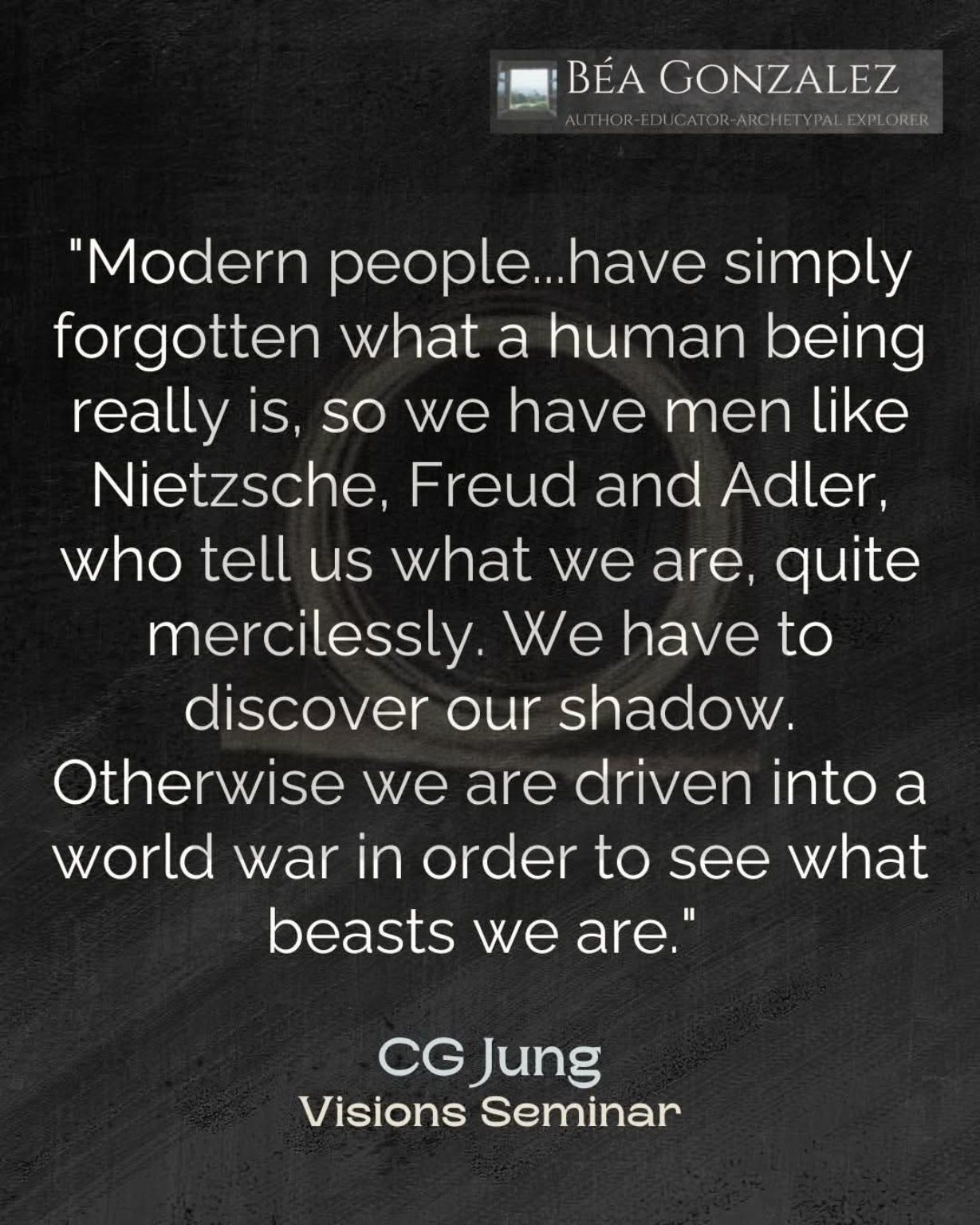
Jung’s framing places the problem primarily within the individual psyche. In his view, the work is introspective and psychological. We are told to discover what is hidden inside ourselves, because the danger lies in unacknowledged inner drives that turn us into beasts when left unconscious. Even when Jung critiques modernity, the psyche remains the central site of failure and repair.
From a moyo and Structural–Relational Power Ecology perspective, we see violence beginning with broken relational ecologies. War and cruelty do not emerge because individuals failed to look inward enough. They emerge because systems dismantled shared regulation, collective accountability, and moral repair, then forced distress inward where it could only be experienced as private pathology.
Where Jung asks me to discover the shadow within, my research, feminist theory, and SRPE ask me to examine the shadow cast by our institutions. I shift the question from “What beasts are we inside?” to “What kinds of systems make human beings forget who they are and behave in inhuman ways?” In this framing, violence is not proof of innate savagery; it is evidence of relational collapse at scale. The danger is not that people have forgotten their darkness, but that they have been made to carry it alone, disconnected from the collective structures that once transformed harm into repair rather than crisis.
Conclusion: Returning to the Breath
Structural–Relational Power Ecology offers the West a way back to something it lost when it abandoned relational worldviews in favor of control, extraction, and individual blame. It does not ask Western systems to become Indigenous, nor does it romanticize the past. It provides a structural method for recognizing what Indigenous cultures never forgot: that human regulation is collective, meaning is shared, and harm shows up in bodies and behavior when relational systems fail.
To return to the breath, in this sense, is ecological. Breath is how regulation moves through bodies, how safety is felt, and how emotion, morality, and belonging synchronize across people. When shared regulation is intact, breath is coordinated through rhythm, presence, and mutual recognition. When it is broken, breath becomes shallow, guarded, and privatized, and distress is misread as individual weakness and pathology rather than a shared relational injury.
SRPE helps Western institutions see what they have been diagnosing without understanding. It reconnects nervous system distress to legal structures, economic arrangements, family disruption, and moral frameworks. It restores the missing layers between policy and pathology. Instead of asking why individuals fail to regulate themselves, SRPE asks why the environments that once held regulation together have been dismantled and who benefits from that dismantling. In doing so, SRPE does not reject psychology, law, or medicine. It contextualizes them and returns diagnosis to description, responsibility to relationship, and healing to reintegration. It shifts the goal from compliance to coherence, punishment to repair, and control to care.
Returning to the breath means relearning how to feel together without fear and design systems that support co-regulation rather than erode it. It means recognizing that what Western cultures call mental illness, deviance, or disorder often marks the exact places where shared responsibility has been severed, because distressed behavior is communication of relational rupture in need of collective repair. SRPE offers a way to see those signals clearly and respond at the level where change is actually possible.
“I can’t breathe” describes the physiological endpoint of broken shared regulation, where law, policing, economics, and racial hierarchy have converged to constrict the relational field itself. From an SRPE and moyo perspective, the breath is where structure meets the nervous system; the body carries what the system refuses to hold. The breath is constrained, fragmented, and forced inward. Structural–Relational Power Ecology is a framework for decolonizing and re-creating shared space in the relational field that makes us collectively human.
References
Barrett, L. F. (2006). Are emotions natural kinds? Perspectives on Psychological Science, 1(1), 28–58. https://doi.org/10.1111/j.1745-6916.2006.00003.x
Barrett, L. F. (2014). The conceptual act theory: A précis. Emotion Review, 6(4), 292–297.
https://doi.org/10.1177/1754073914534479
Barrett, R. A. (1984). Culture and conduct: An excursion in anthropology. Belmont, CA: Wadsworth Publishing Company.
Blackhawk, N. (2023). The rediscovery of America: Native peoples and the unmaking of U.S. history. Yale University Press.
Blakemore, E. (2023). Doctrine of Discovery: How the 500-year-old Catholic decree encouraged colonization. National Geographic.
Ethridge, R. (n.d.). The European invasion and the transformation of the Mississippian world, 1540–1715. Course reading excerpt.
Fountain, S. M., & McCoy, R. R. (2017). New peoples and shatter zones. In History of American Indians: Exploring Diverse Roots. ABC-CLIO.
Porges, S. W. (2011). The polyvagal theory: Neurophysiological foundations of emotions, attachment, communication, and self-regulation. New York, NY: W. W. Norton & Company.
Porges, S. W. (2004). Neuroception: A subconscious system for detecting threats and safety. Zero to Three, 24(5), 19–24.
Snow, I. S. (2025). Autism in America: One woman’s search for healing. Spirolateral press. Amazon Kindle and paperback.