
The Contact Zone Never Closed
(That awkward moment when you're being digested so slowly that you don't even notice you're being eaten alive)

Living Inside the Contact Zone: The Doctrine of Discovery and the Ongoing Production of Inequality
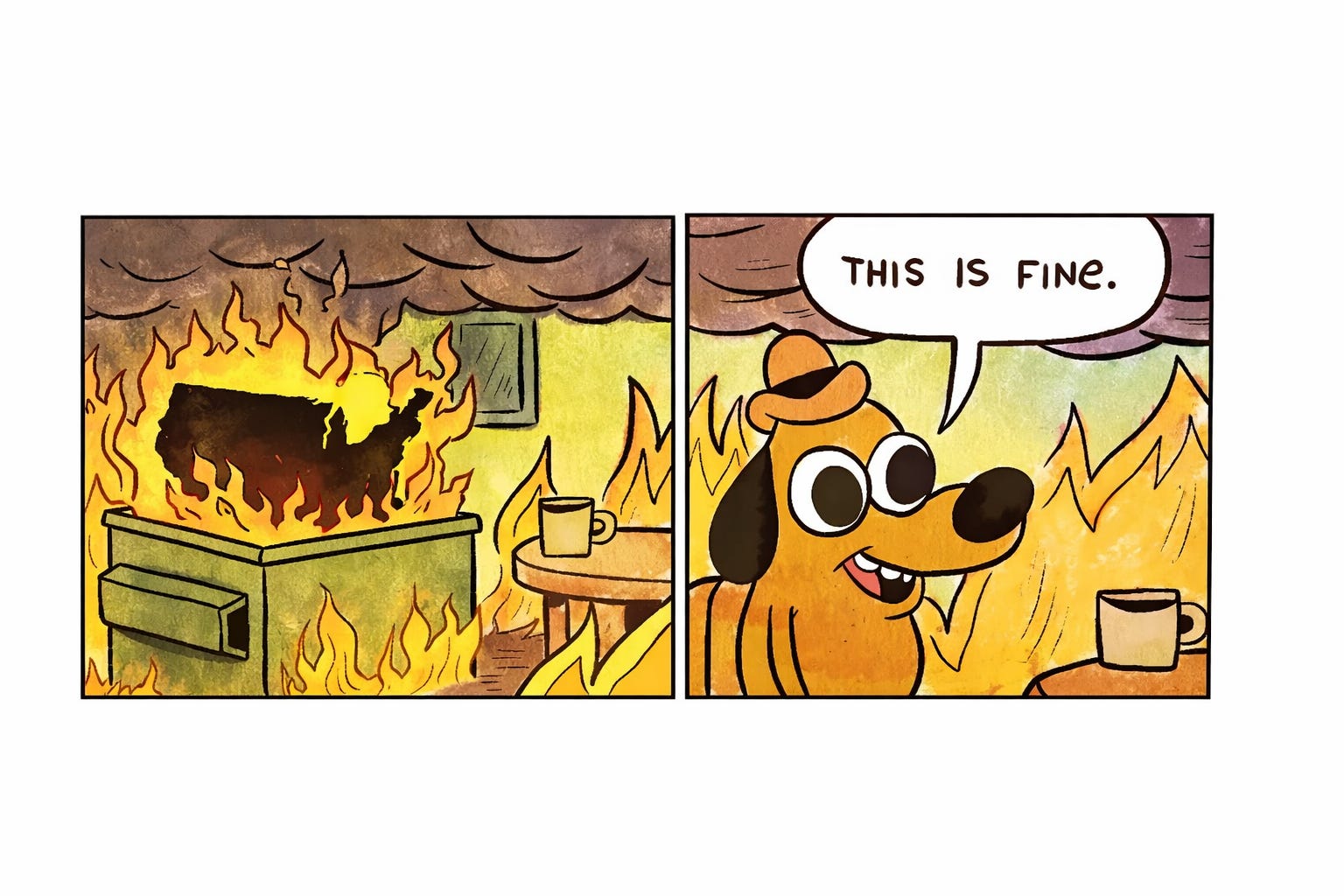
An indigenous contact zone is a social and geographical space, coined by Mary Louise Pratt, where disparate cultures, specifically indigenous populations and colonial settlers, meet, clash, and grapple with each other, often within contexts of highly asymmetrical power relations. It emphasizes the co-presence, interaction, and ongoing negotiation of power rather than simple conquest.
Contact zones between Indigenous peoples and Europeans are active and ongoing, so phrasing the question of colonialism in the past tense is historically inaccurate because it falsely portrays the campaign as having ended when, in reality, we are currently living inside it, being eaten alive. The Doctrine of Discovery provided the ideological and legal justification for a culture based on dominance. The YouTube video “The Doctrine of Discovery: Domination Language of the Papal Bulls” discusses this in depth and describes how language was used to shape patterns of dehumanization and domination. This is a topic I go into further in my own recent article on Substack titled “The Intersection of Fascia, Fascism, and Language.”
Blakemore discussed how inequality was legally and spiritually sanctioned in the article “How the 500-year-old Catholic decrees encouraged colonization,” which shaped every contact zone Europeans entered and every subsequent engagement. Ethridge and Fountain McCoy show that these zones often became “shatter zones,” where Indigenous societies were forced to reorganize under force.
Blackhawk states that “encounters, rather than discovering, must structure America’s origins story” (p. 3), arguing that understanding American history requires centering these contact zones and early encounters because they expose the enduring structures of dispossession and ongoing power imbalances. Fountain and McCoy capture contact zones as mutual encounters at first, but they quickly became unbalanced, asymmetrical, and violent as Europeans unmasked their true goals of domination and extraction. In New Peoples and Shatter Zones, they state that “both Taínos and Europeans shaped the initial confusion and misrepresentations, but events would soon reveal insurmountable divisions between Taínos and Spaniards” (p. 1).
To me, this sounds like a historical interpretation of what modern-day Milton calls “the Double Empathy Problem.” I have previously written about how this might be related to parasitical activities in European intestines, which makes the comments made in the YouTube video on the Doctrine of Discovery: Papal Bulls regarding the linguistic origins of the word “colonize” being rooted in the Latin “colon” ironic, as colonization quite literally is linguistically equivalent to a digesting activity where predators devour and consume. The language of domination used by the Catholic Church continues to be used to this day, displacing indigenous relational languages that are rooted in the land itself.
Colonization is an ongoing process, which basically means we are slowly being eaten alive. Robbie Ethridge states in From Chicaza to Chickasaw that “not until the native peoples became engaged in the world economy through contact with the English, French, and Dutch did they revamp their social, political, and economic orders… the creation of the Mississippian shatter zone” (p. 2).
Using Blackhawk’s centering of initial encounters to understand American history, we can identify that this cannibalistic culture began when relational Indigenous economies based on reciprocity and mutual aid became corrupted by the introduction of a colonist economy based on goods exchanged for currency. This began what Blakemore described as sanctioned inequality and power imbalances that persist in America to this day.
What Fountain/McCoy describe as misinterpretations and what Milton describes as the double empathy problem occur because it is difficult for a relational culture to understand sociopathy, but that’s ultimately what all colonizers are. Colonized cognition*** relies on a hierarchical mode of thinking that limits the ability to shift perspective and empathize. Ethridge argues that money is truly the root of all evil and creates this hierarchical shift in cognition, which Ethridge clearly identifies as a documented historical shift in the entire indigenous population’s organization following first contact. Therefore, if our world is to escape being cannibalized and eaten alive, we will have to return to systems-based ways of thinking, interdependent ways of existing, ecological ways of knowing and being, with a relational, goods-based economy.
***Definition: Colonized Cognition (taken from this earlier post)
Colonized cognition refers to a condition in which individuals or populations are compelled to interpret, regulate, and evaluate their bodily, affective, and cognitive states through a dominant linguistic–epistemic framework that is not semantically or relationally native to their lived experience. This imposition constrains meaning-making, disrupts embodied regulation, and produces adaptive responses that are subsequently misrecognized as pathology.
Colonized cognition does not denote false beliefs or ideological indoctrination at the level of conscious thought. Instead, it describes an epistemic and regulatory capture that operates pre-reflectively, shaping which bodily signals are intelligible, legitimate, and governable within a given social order.
Necessary Conditions
Colonized cognition arises when the following conditions co-occur:
Semantic Non-Equivalence
The dominant interpretive language (e.g., psychiatric, administrative, or institutional language) is not semantically equivalent to the local or embodied meaning systems through which individuals experience affect, distress, and regulation. Emotional and interoceptive states are translated into categories that reorganize or flatten their original relational significance.
Empirical basis: Jackson et al. (2019)Interpretive Asymmetry
Authority over meaning is centralized within institutions (e.g., medicine, law, education), such that individuals are required to adopt externally imposed interpretations of their own bodily states to access legitimacy, care, or survival resources.
Theoretical basis: Foucault; Bourdieu; FrickerRegulatory Consequence
The imposed semantic framework alters how physiological activation is regulated, privileging internal self-control, suppression, or normalization over relational co-regulation, contextual interpretation, or ecological adaptation.
Physiological link: CDR, interoception research, fascia signalingAdaptive Misrecognition
The resulting physiological and behavioral adaptations to this constraint (e.g., hypervigilance, dissociation, sensory sensitivity, attentional divergence) are labeled as individual deficits or disorders rather than recognized as context-appropriate responses to epistemic and regulatory compression.
Observed in: Autism, anxiety, ADHD prevalence patterns (Solmi et al., 2022)
Core Characteristics
Pre-cognitive: operates before conscious belief
Embodied: inscribed in autonomic, metabolic, and connective-tissue regulation
Hermeneutical: limits what can be meaningfully experienced
Administrative: becomes visible where classification systems are densest
Distinction from Related Concepts
Not false consciousness
Colonized cognition does not require deception or ignorance. Individuals may accurately perceive material conditions while remaining constrained in how their bodily responses are interpreted or validated.Not cultural difference alone
Cultural variation becomes colonized cognition only when one meaning system is imposed as universal, authoritative, and compulsory across contexts.Not purely linguistic determinism
Language is a regulatory substrate, not the sole cause. Colonized cognition emerges from the interaction of language, physiology, institutional power, and chronic threat.
Functional Consequences
Colonized cognition produces a characteristic pattern:
Narrowed interpretive bandwidth for affect and distress
Chronic autonomic activation or defensive shutdown
Reliance on internalized self-regulation under semantic scarcity
Pathologization of adaptive divergence (e.g., neurodivergence)
Stabilization of existing social orders through individualized diagnosis rather than systemic repair
Theoretical Implication
Colonized cognition provides a unifying framework for understanding how political, linguistic, and economic domination extend into the regulation of bodies and minds without requiring overt coercion. It explains how nervous systems bear the cost of epistemic and institutional constraints, and why adaptive metabolic states can be misclassified as psychiatric disorders under regimes of semantic uniformity.
Epistemic Grounds
Emotion semantics show both cultural variation and universal structure (Jackson et al., 2019), which provides empirical justification for treating emotion language as regulatory infrastructure rather than a neutral description.
Jackson et al. demonstrate that:
Emotion terms are not semantically portable across languages
Meaning varies systematically by language family, geography, and cultural contact
Emotion concepts are learned interpretations of physiological activation, constrained by valence and arousal but organized by language-specific semantic networks
Therefore:
If emotion words are how physiological activation is interpreted, shared, co-regulated, and socially responded to, then exporting a single emotion-semantic grid (e.g., DSM-derived English affect categories) necessarily exports a specific nervous-system governance regime.
REFERENCES
Blakemore, E. (2019, October 30). How the 500-year-old Catholic decrees encouraged colonization. National Geographic.
https://www.nationalgeographic.com/history/article/how-500-year-old-catholic-decrees-encouraged-colonization
Blackhawk, N. (2006). Violence over the land: Indians and empires in the early American West. Harvard University Press.
Ethridge, R. (2010). From Chicaza to Chickasaw: The European invasion and the transformation of the Mississippian world, 1540–1715. University of North Carolina Press.
Ethridge, R., & Shuck-Hall, S. M. (Eds.). (2009). Mapping the Mississippian shatter zone: The colonial Indian slave trade and regional instability in the American South. University of Nebraska Press.
Fountain, S. M., & McCoy, R. R. (2009). New peoples and shatter zones. In R. Ethridge & S. M. Shuck-Hall (Eds.), Mapping the Mississippian shatter zone: The colonial Indian slave trade and regional instability in the American South (pp. 1–22). University of Nebraska Press.
Milton, D. (2012). On the ontological status of autism: The “double empathy problem.” Disability & Society, 27(6), 883–887. https://doi.org/10.1080/09687599.2012.710008
Snow, I. (2024). The intersection of fascia, fascism, and language. Substack.

Weiss, B. (2019, March 30). The Doctrine of Discovery – “Domination” [Video]. YouTube.
The linguistic etymology of colonize from colon is a detail I hadn't seen before, and it reframes the whole metaphor in a way that's almost too on-the-nose. Connecting contact zones to the double empathy problem makes sense when thinking about how relational Indigenous economies couldn't easily interpret sociopathic extraction systems. The colonized cognition framework feels relevant way beyond autism, espcially when applied to anyone whose regulatory needs dont match the imposed semantic grid.
I see this