
New Book Coming Soon!
Autism in America: One Woman's Search For Healing will soon be available.

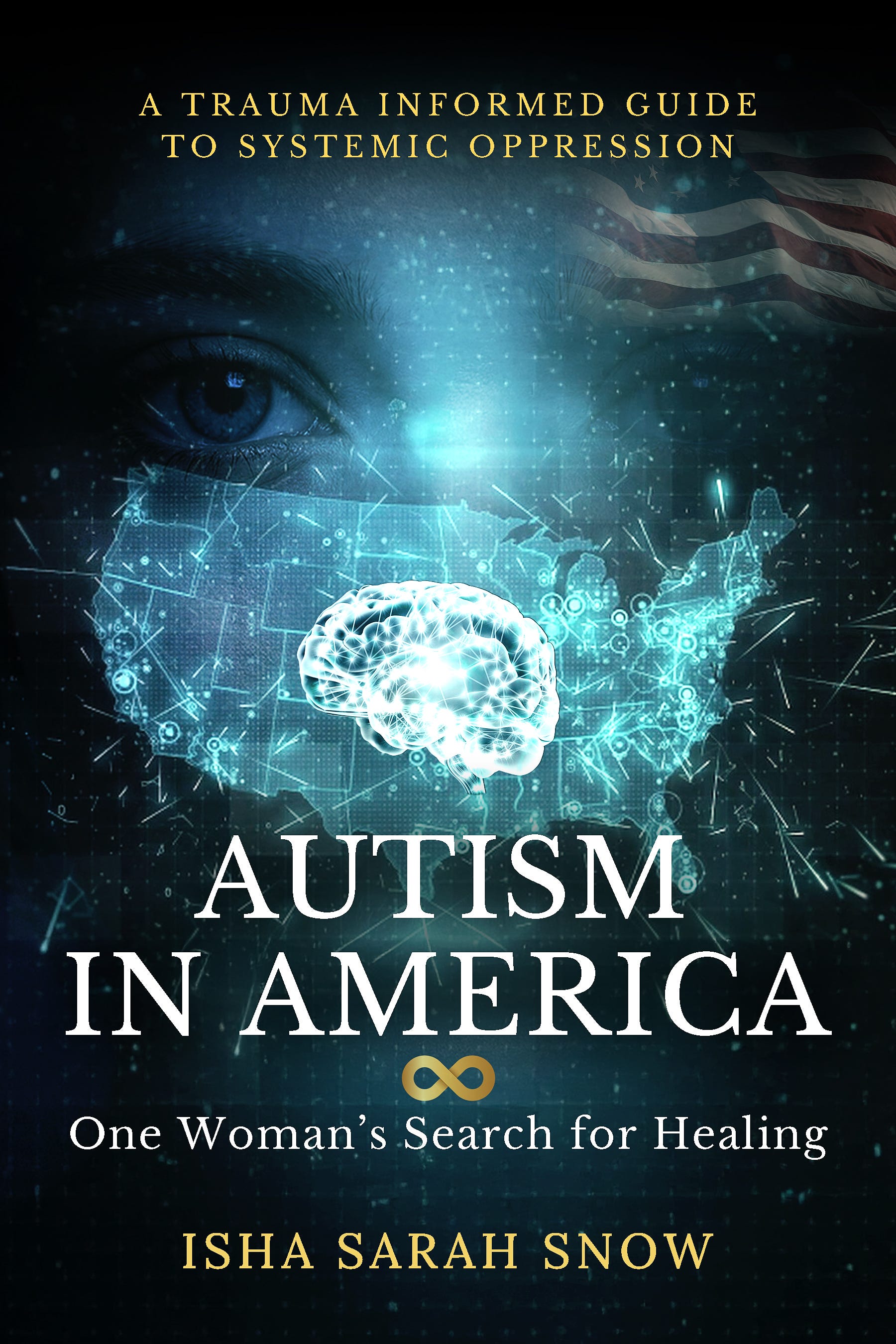
"Autism in America: One Woman’s Search For Healing (A Trauma-Informed Guide to Systemic Oppression)" is a collection of essays that I wrote recently during my first three years of college while studying psychology, anthropology and sociology, first at Lower Columbia College in Longview, Washington and then at Washington State University in Vancouver. The essays explore themes of parenting, neurodivergence, disability, gender, and systemic injustices in America through the lens of a presenting white but indigenous rooted (Leni Lenape) and led woman, who was diagnosed with autism later in life (Asperger’s at age 26 in 2007, later changed to Autism Spectrum Disorder at age 40 along with PTSD in 2021, recently also diagnosed with ADHD in 2025).
Key themes and concepts presented in the book include:
Autistic Standpoint Theory: This is a framework that re-frames autism as a legitimate cultural and cognitive orientation rather than a disorder. The theory is based on the lived experiences and perspectives of autistic individuals and is inspired by the work of Patricia Hill Collins's Black Feminist Thought and Dorothy E. Smith's Institutional Ethnography. "Autism in America: One Woman’s Search For Healing (A Trauma-Informed Guide to Systemic Oppression)" outlines eight features of this theory, two of which are unique to the autistic community: the tension between the viewpoints of parents of autistic children and those of autistic individuals, and the historical erasure of female, transgender and non-binary autistic experiences.
Functional Conflict Perspective (FCP) and Mirror Integration Theory (MIT): These are social theories I have developed that suggest conflict is not a destructive force but a "self-regulating force within complex social systems". FCP views conflict as a signal of systemic imbalance and a potential pathway to transformation. MIT posits that true transformation occurs through "reflective integration," where opposing systems act as mirrors to reveal each other's wounds and potential. Together, they propose a framework for systemic transformation rooted in healing, reflection, and relational sovereignty.
Critique of Western Psychiatry and Social Norms: "Autism in America: One Woman’s Search For Healing (A Trauma-Informed Guide to Systemic Oppression)" argues that Western psychiatric models, rooted in the biomedical deficit model and Cartesian duality, pathologize differences and fail to account for social and relational components of mental health. I suggest that many disorders are "socially constructed" responses to relational ruptures and social trauma. The book also examines how linguistic structures, such as Subject-Verb-Object (SVO) grammar, enforce top-down, colonized cognition or what I define "neurotypical supremacy" as, and which results in the double empathy problem and cultural pathologizing of behavior.
Language and Decolonization: "Autism in America: One Woman’s Search For Healing (A Trauma-Informed Guide to Systemic Oppression)" draws a clear connection between linguistic changes and cultural shifts away from a collective, relational consciousness toward individualism. Most people think of colonization in terms of dividing areas of land by erecting physical borders, not realizing that it is spiritual and intellectual as well. Colonization affects our minds in the same way, for instance, influencing how we label and define things such as our self in relation to our world and each other. (This is also where we come to think of childhood and adulthood as separate events, even though life is a continuous, not linear, process.) Colonization of the mind affected the ways that we relate to each other as separate individuals rather than as members of a tribal or collective grouping; this disconnection dysregulates our nervous systems, resulting in behavioral, emotional and mental disorders, which is the very definition of generational trauma (along with treating distress behavior through a top-down pathologized lens, this describes the process of mental illness through means of social construction). "Autism in America: One Woman’s Search For Healing (A Trauma-Informed Guide to Systemic Oppression)" proposes that indigenous language reclamation could be a path toward mental wellness, social justice and cultural healing by re-indigenizing our ways of knowing.
Global Perspectives on Autism: The book includes an "Autism Global Mapping Project" abstract, which compares the dominant US biomedical model of autism with approaches in other countries. It highlights the importance of a biopsychosocial framework that considers biological, psychological, and social factors. "Autism in America: One Woman’s Search For Healing (A Trauma-Informed Guide to Systemic Oppression)" also emphasizes the role of language and community in shaping autistic identity, using terms like "masking" and "stimming" as examples of the self-defined but ethnographically studied legitimate Autistic culture.
Parenting and Social Class: My research in "Autism in America: One Woman’s Search For Healing (A Trauma-Informed Guide to Systemic Oppression)" connects punitive parenting methods with lower cognitive complexity and difficulties in emotional regulation in adulthood. The book links these issues to social class, arguing that lower-class parents, lacking resources and knowledge, tend to adopt more authoritarian and punitive parenting styles, which in turn stunt their children's development and limit their life chances. This social stigma in Western culture is individualized and pathologized due to the top-down, colonized cognitive processes, which allows for systemic injustices to continue rather than being questioned collectively.
Core Frameworks and Theories
Autistic Standpoint Theory: This framework is presented as an original theoretical contribution. It is grounded in my own lived experience and draws inspiration from established sociological concepts like Patricia Hill Collins's Black Feminist Thought and Dorothy E. Smith's Institutional Ethnography. "Autism in America: One Woman’s Search For Healing (A Trauma-Informed Guide to Systemic Oppression)" does not claim that this theory is widely recognized or accepted in academic circles outside of my own work, but rather that it is an "emergent framework" and a "genealogy" that I have developed in contrast to mainstream neurotypical discourse.
Functional Conflict Perspective (FCP) & Mirror Integration Theory (MIT): These are also presented as original theories developed by myself. "Autism in America: One Woman’s Search For Healing (A Trauma-Informed Guide to Systemic Oppression)" positions FCP as a synthesis of functionalism and conflict theory, and MIT as a framework for understanding relationships as mirrors for personal and collective healing.
Specific Claims and Supporting Evidence
Brain Structures and Attachment: The essay and research paper "Western Parenting Impacts on Human Development and Behavior" contained in "Autism in America: One Woman’s Search For Healing (A Trauma-Informed Guide to Systemic Oppression)" claims a direct link between punitive discipline and an "underdeveloped right Orbitofrontal Cortex (OFC)". It also connects this brain area to "maternal bonding" and the control of reward and punishment-related reinforcers. This claim is supported by a citation from a Neuroscience study (Vahid et al., 2018). The document states that a poorly developed OFC is correlated with attachment disorders and communication difficulties. This is a claim of correlation, not causation, but it is strongly supported by a number of other cited studies cited in the book.
Critique of the APA and Eugenics: "Autism in America: One Woman’s Search For Healing (A Trauma-Informed Guide to Systemic Oppression)" claims that the American Psychological Association (APA) has a history of supporting white supremacist policies and eugenic theories. It cites the APA's 2021 formal apology to communities of color and a 2022 special report in the APA's
Monitor as evidence for this. The book also mentions a review conducted by the Cummings Center for the History of Psychology at the University of Akron that detailed the APA's involvement in eugenic theories and segregationist policies. These claims are supported by multiple internal citations from the APA and the Cummings Center.Globalization and Violence: The book references a book edited by J. Friedman, Globalization, the State, and Violence (2003) , which it says "links economic restructuring under global capitalism to shifts in sovereignty, citizenship, and identity". The book then uses Peter Evans's 2008 article, "Is an Alternative Globalization Possible?" , to discuss the "double movement" of market expansion and societal pushback. My interpretation of these works through the lens of FCP is an original contribution within "Autism in America: One Woman’s Search For Healing (A Trauma-Informed Guide to Systemic Oppression)".
Linguistic Claims (SVO vs. other structures): "Autism in America: One Woman’s Search For Healing (A Trauma-Informed Guide to Systemic Oppression)" claims that English's Subject-Verb-Object (SVO) grammatical structure has colonized Western cognitive processes by "centering the author, which reinforces judgment, shame, blame, punitive punishment... and creates a social structure based around power and control". It cites the Cambridge Encyclopedia of Language for the fact that SVO and SOV structures account for over 87% of the world's languages, and mentions that languages like Navajo, Tagalog, and Hawaiian challenge this structure. These are claims about linguistic structure, and the interpretations of their psychological and cultural effects using the Sapir Whorf hypothesis are presented as a part of my greater theoretical work.
Summary
"Autism in America: One Woman’s Search For Healing (A Trauma-Informed Guide to Systemic Oppression)" is primarily a collection of essays and research projects written by myself, Isha Sarah Snow. The central claims regarding the novel theoretical frameworks (Autistic Standpoint Theory, FCP, MIT) are presented as original contributions and are supported by internal reasoning. Many of the specific claims within the essays are supported by citations to external academic sources, including books, journal articles, and government reports. These citations are used to support claims about autism prevalence, psychological theories, the history of the APA, and linguistic structures. "Autism in America"‘s claims are therefore a mix of original, unverified theoretical frameworks and claims that are grounded in and supported by cited, published research from other scholars.
I am so incredibly excited to be sharing what I’ve learned with you and to be publishing these ideas, based on my individual learned experience gained while healing my individual trauma and helping my family to heal from its generational traumas, in the form of a series of essays collected here in my first book.
This sounds fascinating and I can’t wait to read it! Where will it be available for purchase?