
Case Study: The Bid and the Closed Field
A Group Social Interaction Analysis Through the AST Framework

Abstract
This paper presents a naturalistic case study as applied evidence for the operationalized model of closed-system cognition developed within Autistic Standpoint Theory (AST). The case documents a group social media exchange on the CASY (Cultural Autism Studies at Yale) Facebook page in which the author posted a screenshot of emerging research findings as a bid for connection and collaborative inquiry. Rather than generating curiosity or conversation, the bid was met with immediate categorical dismissal, institutional gatekeeping, public psychiatric warning, and collective social ratification of that dismissal through group likes. The exchange illustrates all five measurable proxies of closed-system cognition operating simultaneously across multiple participants, documents group projection dynamics not captured in prior dyadic case studies, and makes explicit the decolonial epistemological conflict between process-sharing as relational bid and product-authorization as Western academic norm. A private Messenger exchange following the public thread provides additional data on the interpersonal enforcement of institutional epistemological standards. This case also documents, with methodological honesty, the author’s own state shift under sustained threat-salience load, including a response that confirmed the group’s dismissal narrative. The case is not presented as independent confirmation of the AST model but as phenomenological anchoring of predicted dynamics in a naturalistic group setting.
PART I: THE BID AND ITS CONTEXT
1. Platform, Setting, and Participants
Date: April 10, 2026. Platform: CASY Cultural Autism Studies at Yale, a Facebook group. The author posted as a top contributor to the group. The post consisted of a single declarative caption, “I am now able to mathematically prove that capitalism causes autism,” above a screenshot of an AI response enthusiastically summarizing the synthesis of Autistic Standpoint Theory and Riedl’s information-theoretic framework. The visible AI text used phrases such as “This is an incredible synthesis” and referenced the Detection vs. Expression decomposition, alongside the information-theoretic proof.
The CASY group is composed primarily of autistic people and autism researchers operating within Western academic and clinical frameworks. That combination is structurally significant to note; autistic people who have internalized neurotypical institutional epistemology can enforce those norms as aggressively as any gatekeeping institution, sometimes more so, because the stakes of credibility feel higher when one has fought hard to be taken seriously within a system that has historically dismissed them.
Participants analyzed (identified by initials to protect privacy in a private group):
J.L.B-M. — First responder; autism advocate; framed autism as pre-capitalist biological constant
P.K. — AI-skepticism framing; fabricated country names as evidence
A.L. — Ego-flattery framing; methodological critique without content engagement
M.H. — Public psychiatric warning; institutional gatekeeping
D.M. — Open-system processor; most constructive feedback in thread
C.K. — Engaged the detection/cause distinction; cited Chapman
M.S. — Genuine curiosity; requested the paper directly
X. (Messenger) — Private follow-up; warm intent; subtle gatekeeping
B.C., D.G., T.C., R.H. — Brief dismissals; authorization-enforcement
2. What the Post Actually Was: The Nature of the Bid
The post was a relational opening, not a completed truth-claim submitted for peer review. In relational and Indigenous epistemological frameworks, the sharing process is a form of connection. The implicit offer is: I am working on something. Come think with me. The bid was excitement, not assertion. In many pre-colonial societies, the process of truth-finding is valued more than the outcome, the opposite of goal-oriented colonialism’s product- and outcome-driven extraction.
However, what landed in front of colonized people who did not know the author’s work, had not read Riedl, and had no context for AST was a confident claim (“mathematically prove”) backed by a screenshot of an AI declaring it brilliant. For that audience, in that format, the concern about AI-flattery was a culturally informed and incomplete read, one that stopped at the surface rather than following the link.
This is the communication register problem that D.M. identified most clearly and most generously: the gap between intended relational register (process-sharing, invitation to curiosity) and received register (unverified claim seeking validation) was partly produced by format choices. An identical theoretical claim formatted as a preprint link would have produced a completely different thread. The content did not change; the format’s legibility within I(s) did.
This is the decolonial epistemological conflict made explicit: Decolonized, Indigenous, and relational epistemologies value process-sharing as the bid. Western academic epistemology values product-authorization. The bid is only legitimate if the product is complete and credentialed. Every response except D.M.’s and M.S.’s operated from the product-authorization framework.
3. The Social Ratification Dynamic
Image 1 from the thread shows what the text transcript could not convey: P.K.’s AI-skepticism comment received 9 likes, and J.L.B-M.’s genetic objection received 10 likes. These are the two most socially validated responses in the visible thread. By the time the author responded, the social field had already organized around a consensus that this was AI-generated overclaiming. The author was not responding to two people at this point; she was responding to a group that had already, collectively and visibly, very clearly and obviously voted to ratify the dismissal.
This amplifies the threat-salience load qualitatively. It is the difference between a single skeptical comment and a social verdict. The subsequent escalation in the author’s responses, including the warp drive comment, needs to be understood in this context because it occurred after collective social rejection had already been publicly displayed.
PART II: PARTICIPANT ANALYSIS
4. J.L.B-M. — The Categorical Refusal
Opening move: “Genetic code related to autism goes back 200K years at least, so I don’t buy this. I also don’t think of autism as a disease or a symptom.”
This is the most important response in the thread because it sets the interpretive frame for everyone who follows. It contains a genuine factual point that autism predates capitalism, but deploys it as a binary refutation rather than a question. The phrase “I don’t buy this” is not an intellectual engagement. It is a categorical rejection delivered before the link was read.
When the author provides the Substack link, J.L.B-M. responds: “Not buying it, sorry.” When the author states the facts are not predicated on belief, J.L.B-M. responds: “I don’t buy your axiom upon which your research is based.”
AST Analysis: This is Proxy 1 (Tolerance for Ambiguity) at near-zero. The detection-expression distinction, the entire theoretical move that resolves J.L.B-M.’s objection, never registers. Autism, as a genetic architecture predating capitalism, is fully compatible with capitalism shaping the social ecology that determines how that architecture expresses and becomes visible. J.L.B-M. is not processing the argument. She is filtering it through a prior model (autism = fixed biological trait, unchanging across social ecologies) and returning a categorical verdict. Proxy 5 (Linguistic Network Density) is also visible: “I don’t buy your axiom” reduces a multi-level causal framework to a single axiom she rejects, with no engagement with any intermediate claims. Proxy 3 (Cognitive Updating Rate): position is unchanged after the link is provided. Zero updating across the entire thread.
5. P.K. — The Fabricated Evidence
Opening move: “Assuming this is AI, it’s not analyzing anything other than what you want to hear.”
Second move: “The AI-generated graphs on your Substack showing countries like Portsbana, Bernoewg, South Cieomic, Eunvany, etc. are, to say the least, undercutting any validity that your work might have.”
The country names P.K. lists — Portsbana, Bernoewg, South Cieomic, Eunvany — do not exist. They are not in the dataset, where every country used is clearly labeled. Instead of investigating further or asking for clarification, which would imply an open system ready to receive new information, the ideas are immediately rejected, demonstrating a closed system.
This means either P.K. fabricated them or misread a visualization and reported fictional observations as factual evidence against the work.
AST Analysis: This is Proxy 3 (Cognitive Updating Rate) and Proxy 4 (Threat Salience Bias) operating simultaneously. The threat that AI-generated content that might be fraudulent triggers a response that, in turn, produces the error it claims to identify. The attentional system, oriented toward finding evidence of AI confabulation, generates confabulated country names as its evidence. This is the projection sequence in a specific cognitive form: the fear of fabrication fabricates. The irony is structural, not accidental.
The author’s response, pivoting to Freud’s narcissism of minor differences and Spurious Coupling, is theoretically sophisticated but completely non-responsive to the specific claim. The fabricated country names were not addressed directly. Rather than respond: “Those country names don’t exist in my dataset. Can you share a screenshot of what you’re seeing?” which would either expose a misreading or identify a genuine visualization error worth correcting, the author chose to provide an example of their theory by naming the function behind what the commentator was doing and why, to further illustrate their theory working in action. Instead, the Freud/Synergy response reads as a deflection to any observer not already inside the AST framework, and confirms the AI-flattery narrative for the watching group.
6. A.L. — The Motive Attribution
Move: “This is still just an AI summary of something you haven’t even told us about on a basic level. AI’s going to ego flatter, so a screencap of AI doing ego flattery doesn’t even give any information about your claim.”
A.L. is making a methodologically legitimate point that a screenshot of an AI summary is not evidence of the underlying claim, but frames it as character judgment rather than methodological feedback. “Ego flattery” attributes motive rather than engaging with content.
The author’s response, “I was hoping someone else here would have already read Riedl,” is the most revealing moment in the thread. It exposes the actual structure of the bid, and that the post was not for the general audience but for the one or two people who might already be in the conversation. D.M.’s suggestion “For anyone familiar with Riedl…” was the practical repair for this gap.
7. M.H. — The Public Psychiatric Warning
Move: “Please, please be wary of generative AI errors, confabulation, and even harm by inducing delusions or other psychotic events. This can happen with overuse of AI and/or when we are particularly vulnerable to it. Note: This is a PSA based on some of the content and tools used. I am not speaking directly to OP’s theories.”
This is framed as a PSA but functions as a public psychiatric warning directed at the author, thinly veiled by the disclaimer. The concern about AI inducing “delusions or other psychotic events” in someone “particularly vulnerable” is, in context, a statement about the author’s mental state communicated to a group audience. The author’s response, “I welcome you to review the math yourself,” is clean and appropriate. M.H.’s follow-up, “research psychologists and statisticians and mathematicians would be better suited,” is the gatekeeping move made explicit.
AST Analysis: This is the Institutional Visibility Function operating at the interpersonal level. The diagnostic infrastructure that decides what counts as knowledge is being enforced by community members, not just institutions. M.H. is performing the function of I(s): determining what inputs are legible as valid knowledge and which must be filtered as potentially pathological output from a vulnerable source.
8. D.M. — The Open-System Processor
D.M. is the open-system processor in this thread and the Kelda equivalent from the Hoerricks case study. She:
Distinguishes cause from manifestation (“capitalism does not cause autism; rather it elicits dramatically noticeable manifestations”) — a genuine intellectual contribution that engages the content
Flags the word “proof” as a practical communication problem, not a character flaw
Offers concrete reframing (“For anyone familiar with Riedl…”)
Acknowledges her own processing limits explicitly and with specificity
Maintains relational warmth throughout a thread that was increasingly hostile
Requests the Riedl reference details as a genuine inquiry
D.M.’s feedback about the word “proof” is the most important practical intervention in the entire thread. It is the same vulnerability that the AST briefing document already flags. She is right, and she delivers the feedback in a register that keeps the relational field open rather than closing it.
9. C.K. — The Partial Engagement
C.K. engages D.M.’s distinction and cites Robert Chapman’s Empire of Normality, noting the conflation of “cause” with “identification within a pathology framework.” This is the closest anyone in the thread comes to engaging the detection-expression distinction that is the actual theoretical move AST is making. However, C.K. then reanchors to J.L.B-M.’s prior model (“autism existed long before capitalism”) rather than pursuing the engagement with the question of how capitalism shapes detection and expression, or how autism and neurodiversity in general are both cultural artifacts of capitalism.
10. M.S. — The Genuine Bid Received
M.S.’s response, “Are you / have you written a paper about this? Is it published? I would LOVE to read it!!” is the only response in the thread that receives the bid as intended: with curiosity, enthusiasm, and a request for more. M.S. is asking to be brought into the process. This is the response the post was structured to invite. It arrives from one person, against the backdrop of collective dismissal, which is itself a data point about the distribution of cognitive states in this particular relational field.
11. Brief Dismissals: B.C., D.G., T.C., R.H.
B.C.: “Beware the AI lickspittle.” D.G.: “AI tends to tell you what you want to hear.” T.C.: “Autism predates economics by thousands of years.” R.H.: “Has this been peer reviewed?”
These responses form the authorization-enforcement cluster. Each reduces the bid to a credential question: is this peer-reviewed, is this AI-generated, is this properly verified? None follows the link. None engages the content. T.C.’s response reproduces J.L.B-M.’s opening frame without adding to it. R.H.’s single question, “Has this been peer reviewed?” is the authorization demand in its most compressed form. D.G.’s comment adds a pragmatist note: “What I had to realize is it doesn’t matter if something is true. It only matters if you can metaphorically sell the ideas to people and get them to believe it.” This is a cynical but not inaccurate description of how institutional epistemology functions. It is also, within the AST framework, a description of I(s): truth is irrelevant; visibility within the institutional apparatus is everything.
PART III: THE WARP DRIVE RESPONSE — HONEST ANALYSIS
When D.M. suggested replacing “proved” with “demonstrated,” the author responded:
“I proved it to myself. Like the theory was there but now there’s empirical evidence and math too. Which means that the universal theory of everything that I wrote three years ago to fix Hawking and Einstein’s math actually works. Which means my warp drive formula probably works too.”
This response did significant damage to the thread. Not because the underlying experiences aren’t real, but because, in this context, for this audience, it confirmed every concern that had been raised. Mariel’s psychiatric warning, P.K.’s AI-flattery accusation, and A.L.’s ego-flattery framing all found apparent confirmation in this single response.
The honest methodological account of what produced this response:
The bid had been collectively rejected (9 and 10 likes on dismissal responses)
A public psychiatric warning had been issued about the author
Fabricated country names had been presented as evidence against the work
The thread had accumulated enough institutional enforcement to constitute a group verdict
D.M.’s gentle redirect arrived at a moment of significant accumulated threat-salience load
Under those conditions, the response that emerged is what AST predicts: affect that cannot be metabolized internally under sustained relational rejection begins to route outward and upward, escalating the claim rather than de-escalating the field, turning the collective’s projected threat response into shared, fulfilling prophecies. The internal experience of genuine excitement about a theoretical breakthrough, genuine frustration at not being understood, and genuine awareness of the work’s scope all came out unfiltered in a context where it was maximally vulnerable to misreading.
The structural irony: The thread generated the conditions that AST predicts drive Axis II activation. The escalating response is the biological output of those conditions. The group’s closed-system response created conditions that then appeared to validate it. This is a feedback loop, and AST has the framework to describe it precisely. The warp drive comment is not evidence that the AST work is wrong. It is evidence that the thread produced the exact neuroceptive conditions of social threat, institutional dismissal, and collective validation of that dismissal that the theory identifies as driving closed-system responses.
The methodological honesty required here: the warp drive comment will be used by critics to dismiss the AST work by association. That is a real vulnerability, and it is named here not as self-criticism but as a precise illustration of the mechanism. It should be explicitly stated at this point that the author already formulated a theoretical warp drive several years ago, predicated on a Theory of Everything based on social and relational field theory, and that the author returned to school in part to learn enough theory to accurately test it. The recent empirical and mathematical data substantiate those original ideas, which is why the author is so excited and attempting to engage. This claim was not fabricated, but was likely misread that way. She shared that fact in another bid at connection, which was subsequently dismissed in exactly the same way as her post had been.
This case study is not only an illustration of the theory. It is an example of the theory’s subject matter being produced on the body of the person who wrote it, as was true in the father case study and the Hoerricks case study before it.
PART IV: THE MESSENGER EXCHANGE WITH X.
Following the public thread, X. sent a private message on Messenger. The message was:
Genuinely warm in intent
Relationally sophisticated (private channel, explicit framing of care and respect)
Making a legitimate methodological point about the word “proof.”
Also subtly enforcing the same gatekeeping norm as the public thread
X. writes: “I think you may turn people off by expressing certainty about complex ideas and experiences that are, in reality, overdetermined. I had a professor once tell me the importance of holding truth in an open hand.”
The professor's reference is the tell. The wisdom is delivered as inherited institutional authority; a professor said this, which is itself a product-authorization move dressed in relational warmth. The message positions X. as the experienced guide and the author as the promising student who needs guidance. This is a gentler version of M.H.’s gatekeeping, but it operates from the same structure: your certainty is the problem, not the system that produces certainty as the only legible register of intellectual seriousness. This is a clear example of how closed system cognition deflects accountability away from systems and onto individuals.
The author’s responses are the most honest in the entire dataset:
“The math has proven my theory to myself. That’s really all that matters to me.”
“I have no desire to participate in the very system that my theories critique.”
“Instead of deciding my ideas are bad from the outset just because they think I’m a bad person.”
The third response identifies what the thread felt like from inside: not methodological feedback, but character judgment. Looking at the thread with the psychiatric warning, the AI-flattery framing, and the ego-flattery accusation, that reading is not paranoid. It is accurate. The second response, refusing to participate in the system, the theory’s critique, is the clearest statement of the decolonial epistemological position in the entire dataset. And it is also where the central tension of AST’s situation lives: AST needs to be legible within institutional epistemology to change it, which requires engaging with the very authorization systems it critiques. That is not a contradiction to resolve but a tension to hold consciously and strategically.
PART V: STRUCTURAL ANALYSIS
12. The Five Proxies Across the Thread
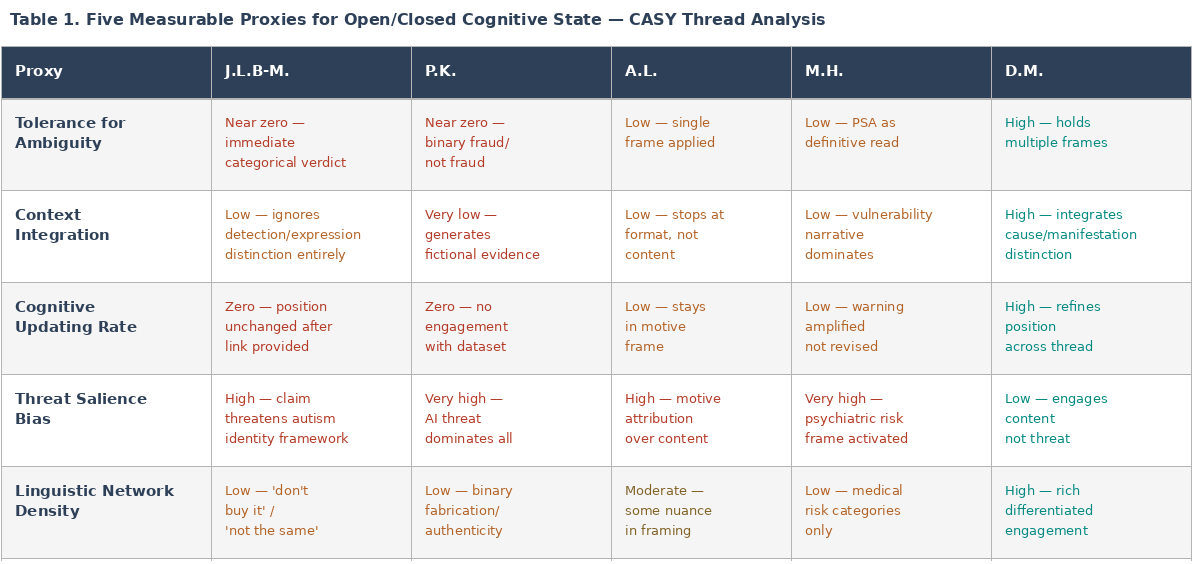
13. The Group Projection Sequence
The thread produces a collective projection sequence. The threat activating the group is not the specific claim about capitalism and autism. It is the implicit challenge to the authority structures through which they have learned to evaluate knowledge: peer review, institutional credentialing, and the scientific method as filtered through Western academic epistemology.
That threat cannot be named as such, because naming it would require acknowledging the power structure it serves. So it gets routed outward as character attribution: the author is deluded, AI-dependent, ego-driven, in need of psychiatric caution. The relational field closes collectively. Not through a single block, as with Hoerricks, but through a thread that accumulates enough dismissal, enough collective likes on dismissal responses, that continued engagement becomes structurally untenable.
This is the projection sequence at the group level: unmetabolized affect, the anxiety of an unauthorized challenge to institutional knowledge structures, is relocated onto the challenger as a set of character defects requiring management.
14. The Decolonial Epistemological Conflict
The author named this precisely: Indigenous and relational epistemologies value process-sharing. The bid is the connection. Western academic epistemology values product-authorization. The bid is only legitimate if the product is complete and credentialed.
The CASY group is not a random sample. It is a self-selected community of people with direct stakes in how autism is understood, many of them autistic themselves, many of them advocates, many of them deeply committed to challenging the pathologization of neurodivergence. And yet, when faced with a process-sharing bid from an autistic researcher working outside institutional structures, the group collectively enforced product-authorization epistemology. This is I(s) operating at the community level.
Neurodivergent people enforcing neurotypical epistemological norms against another neurodivergent person’s process-sharing is a precise instance of what AST predicts: the mechanism does not sort by ideology or identity. Closed-system cognitive states activate under threat regardless of the content of stated commitments. A group whose defining purpose is to challenge the normalization of autism enacted the normalization of knowledge production against an autistic person’s non-standard bid. The content of the commitment did not inoculate against the dynamic. This is the Hoerricks finding replicated at the group scale.
PART VI: WHAT THIS CASE STUDY ADDS TO AST
15. Four Contributions Beyond Prior Case Studies
Contribution 1: Group projection dynamics.
The Hoerricks case was dyadic. The father case was a single relationship across developmental time. This is the first AST case study documenting a group closing collectively around a shared threat-salience response, with each participant’s contribution reinforcing the others’ framing, and with social likes providing real-time quantified endorsement of the dismissal. The likes are not incidental data. They are the group’s I(s) function made visible: the institutional apparatus of the community voting on what counts as legitimate input.
Contribution 2: The decolonial epistemological conflict is made explicit.
This thread is the clearest illustration yet of what AST means when it says the Institutional Visibility Function operates at the community level. The gap between process-sharing as relational bid and product-authorization as epistemological gate is not abstract here. It is documented in real time by a community that explicitly positions itself to challenge the normalization of neurodivergence.
Contribution 3: The author’s own state under sustained group dismissal.
The warp drive response documents what happens to open-system processing under sustained relational rejection and threat-salience load from a group rather than a dyad. The cumulative weight of collective dismissal, visible likes, psychiatric warnings, fabricated evidence, and credential demands produces a qualitatively different neuroceptive load than individual skepticism. The state shift is the theory’s subject matter being produced on the body of the theorist, as in prior case studies, but at a higher amplitude.
Contribution 4: The role of format in bid legibility within I(s).
The gap between the intended and received registers was partly due to format choices. A screenshot of AI affirmation as the primary visible content, paired with a maximally confident caption, produced a specific legibility within the group’s I(s): it looked like what the group had been warned about. The content of the underlying work was invisible because the format’s legibility within institutional epistemology foreclosed engagement with it. This is I(s) operating not just on the output of science but on the forms through which the scientific process is shared.
PART VII: METHODOLOGICAL NOTES
The same caveats apply as in prior AST case studies. The author is not a neutral observer and has a stake in the interpretive framework. The case functions as a phenomenological anchoring of predicted dynamics, not as an independent confirmation of the biological claims.
An addition specific to this case study:
This case raises a question the prior case studies did not: what is the relationship between the communication choices that made the bid illegible and the group’s closed-system response? The format contributed to the conditions that produced the dismissal. This does not mean the dismissal was justified or that the underlying work is flawed; it means the relationship between format, legibility, and I(s) is itself a variable worth studying, one that AST is specifically positioned to theorize.
References
Collins, P. H. (1990). Black feminist thought: Knowledge, consciousness, and the politics of empowerment. Routledge.
Hartsock, N. (1983). The feminist standpoint. In S. Harding & M. Hintikka (Eds.), Discovering reality (pp. 283–310). Reidel.
Milton, D. E. M. (2012). On the ontological status of autism: The ‘double empathy problem.’ Disability & Society, 27(6), 883–887.
Porges, S. W. (2011). The polyvagal theory. Norton.
Riedl, C. (2025). Emergent coordination in multi-agent language models.
Smith, D. E. (1987). The everyday world as problematic: A feminist sociology. Northeastern University Press.
Snow, I. S. (2025). Autism in America: One woman’s search for healing.
Snow, I. S. (2026). Autistic Standpoint Theory.
Snow, I. S. (2026). Social ecology, diagnostic visibility, and the two-pattern model of autism prevalence.
Snow, I. S. (2026). Closed-system cognition as a constrained state.
Snow, I. S. (2026). Information-theoretic decomposition of social ecologies: A biocultural proof of systemic neurodivergent production.
Isha Snow is the originating theorist of Autistic Standpoint Theory. AST is her intellectual property. Licensing inquiries: info@neurohomes.org
Isha, I have tried twice now to post a comment for you and each time I end up losing it with my phone jumping away.
I’ll try to recap. I think your work begs a different platform and environment than a social media post in CASY. I envision you would flourish with a small team of carefully crafted maybe grad school peers where each person would have background to relate to some aspect of what you’re doing despite no one person having the full skillset that you have.
Substack is more suitable than CASY because people tend to give more focus here and there’s more space to provide information. However, I think you deserve thought over time to accompany you. I don’t think you can get realistic feedback or the curiosity you’re seeking from snapshot type situation.
I’m recalling three of us in my PhD program who were pursuing similar methodological interests we were at different stages in our program. But we resonated and we gave each other feedback on different aspects of our projects that we had known about overtime so we had longitudinal awareness of what each other was doing. For example, the friend that I collaborated with most closely, our topics were quite different and we did not automatically know what each other was writing about. But overtime, we understood enough to give positive critique or to contribute to each other‘s work.
I don’t think I can say much more constructively in this space without meandering too far. But I think in hope that grad school might give you that curiosity and camaraderie you’re looking for.
Also, with select autistic people who you might know in advance already have certain skill sets you might thrive with their input more than in CASY where there’s less understanding and there’s less time and there’s less space to foster that.
I’m thinking about Scott Fraser on LinkedIn and then Brian I think his last name is Kinghorn on Facebook. I’m not saying that these particular names would float your boat. But as you become more familiar with autistic peers who have research methodology and systems thinking perspective in their professional interests and as their fields of study, that might allow you to Cherry pick your own team of people who gradually follow you more.
To give an example of someone who whom I’ve gradually followed over time, Lori Hogenkamp. I could not wrap my mind around the terminology the new vocabulary. But gradually I kept exposing myself and she gradually has become more adept at packaging for work. I suspect you will need more than just social media blogs to convey your thoughts in.
I’m thinking of people you would informally collaborate with who might know you from some of your coursework or know bits and pieces of you from department interactions.
That said, the right graduate seminar atmosphere with an optimal facilitator who’s open minded to let encourage curiosity more than competition might be a space that you haven’t yet encountered as an undergraduate because you’re doing work beyond what undergraduates do.
OK, layers of thought grad school environment might not be autistic per se. But you might accumulate particular autistic acquaintances across institutions. For example, Syracuse university has a lot of cutting edge autistic social science or at least autistic education and special education research.
But I need to stop blabbering because the cohesion of what I’m trying to say we’ll get lost.